
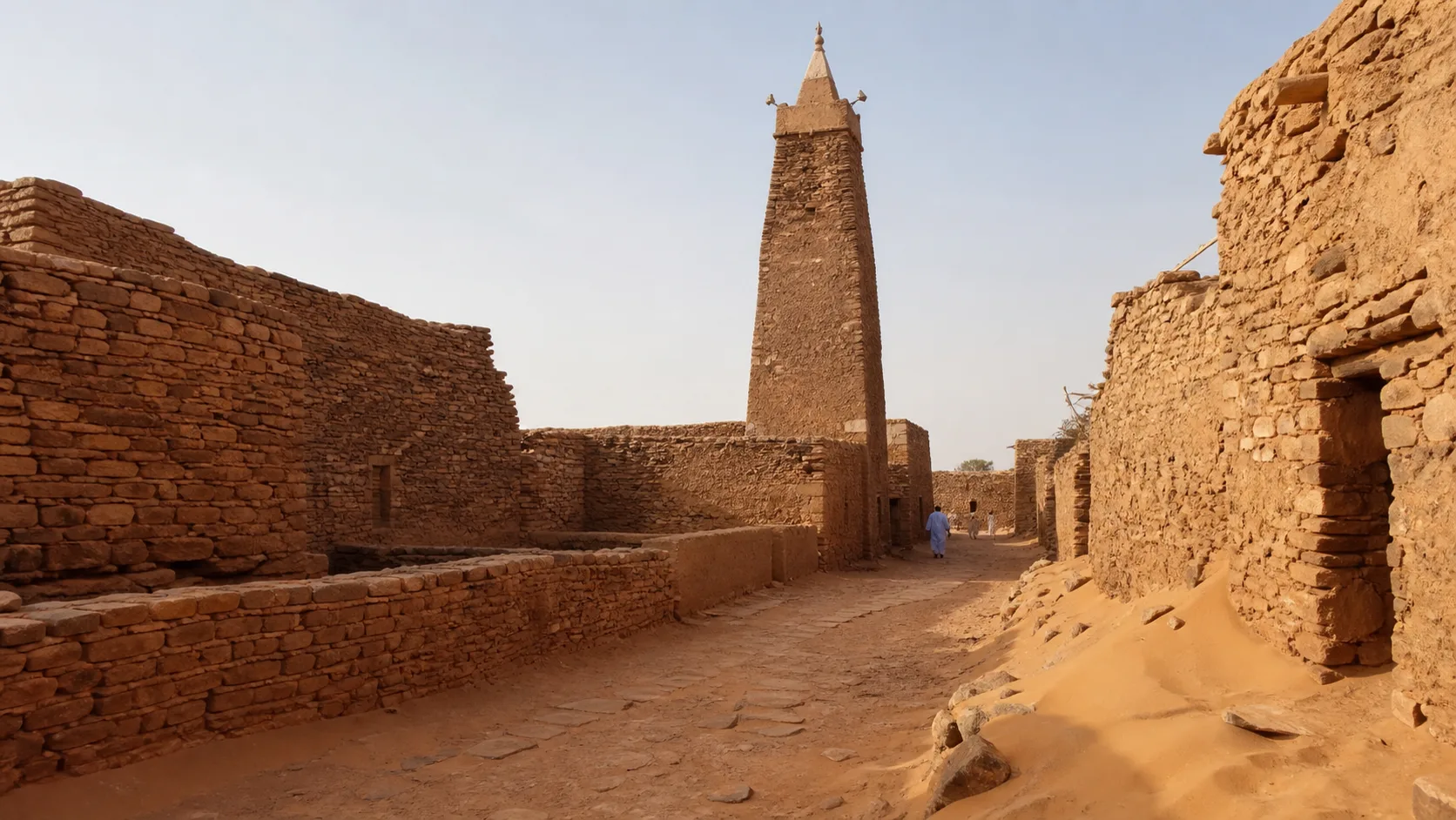
Chinguetti: stone, knowledge and desert
Chinguetti is not a ruin isolated from the present. It is a living Mauritanian town where an old stone ksar, family libraries, religious scholarship and advancing dunes occupy the same landscape. Stay long enough to meet the people who preserve it, not only to photograph the minaret and leave.
Chinguetti: stone, knowledge and desert
Chinguetti is one of the four Ancient Ksour of Mauritania inscribed by UNESCO in 1996. The medieval trading and religious centers developed along trans-Saharan caravan routes and preserve narrow lanes, courtyard houses and a mosque with a square minaret. From Atar, Chinguetti is normally reached by a suitable vehicle through the Adrar. Plan at least one night; two nights allow a library visit, the old town, the desert edge and local life without turning the visit into a race.
Why Chinguetti matters
UNESCO describes the ancient ksour as living historic towns whose architecture records more than seven centuries of human history. Their position between the Maghreb, the western African river regions and the savanna made them stops for trade, accommodation, religious study and the exchange of knowledge.
Chinguetti became one of Mauritania’s best-known centers of scholarship. Manuscripts on religion, law, language, astronomy and other fields were protected in family collections. UNESCO reports that an estimated 30 libraries existed in the eighteenth century; four to six remain operational today, holding roughly 6,000 pieces of documentary heritage. These are not decorative props. They are family responsibilities exposed to heat, sand, flash floods, insects, fragile buildings and the cost of conservation.
What “ksar” means here
The old town is an urban system adapted to the desert. Thick walls of stone and clay reduce heat. Small exterior openings protect privacy and interior spaces. Houses gather around courtyards. Narrow, winding alleys and covered passages create shade, while the mosque and places of learning anchor the settlement.
The streets can feel irregular to a visitor because they follow topography, family groupings and a mode of life different from a planned modern grid. Walk slowly. The value lies in the relationship between architecture, climate and community, not in reaching one isolated monument.
The mosque and minaret
Chinguetti’s square minaret is the visual symbol of the old town, but the mosque remains a place of worship. The respectful default is to appreciate and photograph the exterior from public space without interrupting prayer, blocking an entrance or flying a drone overhead. Follow the direction of residents for any access. Dress modestly and lower the camera when people are entering or leaving.
The building’s power comes from restraint: local materials, heavy walls and a compact form rather than ornamental excess. It belongs within a wider network of mosque, mahadra, homes and libraries.
Visiting a family library
A good library visit begins with the custodian, not the camera. Greet, listen and ask which objects may be photographed. Never open, move or touch a manuscript unless the custodian explicitly invites it and remains present. Avoid flash and do not place bottles, bags or phones on the same surface as a document.
Pay the requested visit fee or make a respectful contribution. That payment recognizes time and preservation work; it is not ownership of unlimited access. If filming commercially or for a large channel, explain the intended audience and agree on permission before recording.
Useful questions include:
- How has the collection passed through the family?
- Which subjects appear most often?
- What threatens the books today?
- How are the manuscripts stored and digitized?
- What would help the library survive another generation?
Myth versus fact
Chinguetti is often marketed as a “seventh holy city of Islam.” This is a tourism expression, not a universal formal rank within Islam. The stronger, verifiable story is already exceptional: Chinguetti was a major western Saharan center of learning and pilgrimage routes, and its family libraries preserve a remarkable documentary tradition.
Treat the phrase as a tourism expression that requires explanation, never as an unqualified religious rank.
The desert edge
One of Chinguetti’s defining experiences is the fast transition from inhabited stone streets to sand. The dunes are not an amusement park behind the town. They are part of the pressure on buildings, gardens, roads and daily life. Walk with a local person at sunrise or late afternoon, follow established paths near homes and avoid driving over untouched crests simply for a photograph.
For a night outside town, use a known camp or an organized bivouac. An open sandy site offers cleaner views and fewer rock shelters for scorpions than a tight stony pocket. Keep shoes and bags closed, use a raised bed when available and check the ground with light before moving at night.
From Atar to Chinguetti
Atar is the practical supply and transport base. The journey crosses Adrar plateau scenery and the Amojjar area before reaching Chinguetti. Road and track conditions vary with sand and rain; use a vehicle appropriate to the current route and a driver who knows the region.
Before departure:
- fill water and fuel in Atar;
- download maps and save the accommodation pin;
- carry passport and visa copies for checkpoints;
- tell the accommodation your expected arrival window;
- avoid beginning so late that the final approach happens in darkness;
- check rainfall because an oued can change the route.
How long to stay
Half-day: old town exterior and one short walk. This is possible but misses the rhythm of the place. One night: old town, one library, sunset or sunrise and a local meal. Two nights: recommended for a serious visit, with time for conversations, a second library or workshop, dunes and rest. Three nights: useful for writers, photographers and travelers integrating a longer Adrar circuit.
Two-day program
Day 1 — Read the town
Arrive before the hottest part of the afternoon or rest until the light softens. Walk the edge between the newer settlement and the old ksar with a local guide. Learn how the walls, courtyards, mosque and lanes respond to heat and social life. Visit one family library without rushing. Finish at a safe dune viewpoint for sunset, then eat and sleep locally.
Day 2 — Knowledge, craft and desert
Begin early in the old town when the lanes are quiet. Visit a second collection, craftsperson or household only through a local introduction. Ask about conservation and the changes residents observe. Spend the middle of the day resting. Later, walk beyond the stone quarter with water and a known route, then continue toward Ouadane or return to Atar before dark.
Where tourism money should go
The strongest local impact comes from ordinary purchases and services:
- sleep in a locally run auberge or camp;
- hire a resident guide;
- pay library visits directly;
- eat meals prepared locally;
- buy crafts from the maker rather than treating every interaction as a free photo;
- commission a driver who maintains a vehicle in the region;
- leave a clear tip for good service without creating unrealistic expectations.
Hospitality and professional service can exist in the same encounter. If a family spontaneously serves tea, receive it as hospitality. If someone spends hours interpreting the town, agree on a professional rate.
Photography plan
The most complete story uses details, not only the minaret:
- Wide old-town context at early light.
- Stone, clay and wood textures.
- A lane showing shade and scale.
- Library custodian portrait with consent.
- Closed manuscript and conservation storage with permission.
- Hands preparing tea or a local craft.
- New town and old town in one visual sequence.
- Dunes pressing against the settlement, photographed without dramatizing residents as victims.
Ask before photographing recognizable people, especially women and children. A distant figure that cannot be identified still deserves consideration if the setting is private.
Best time and weather
The cooler months make walking and desert nights easier, but Chinguetti is not limited to one season. Summer demands earlier starts, a long midday pause and more water. September rain can transform the Adrar and its oueds, but also interrupt vehicle crossings. Winter nights can become genuinely cold, so bring trousers, a warm layer and wind protection.
Food, water, money and connection
Expect simple accommodation and meals rather than a large restaurant scene. Tell the host about dietary needs before arrival. Carry cash in MRU and do not rely on cards. Mobile service can work in town but should not be the only navigation or emergency plan. Bring personal medication and enough water for the road even when the guesthouse provides drinking water.
Heritage conduct
- Do not climb walls or enter roofless structures without invitation.
- Do not move stones to stage a picture.
- Do not touch manuscripts automatically.
- Do not photograph worship or private courtyards without consent.
- Do not fly drones over homes or the mosque.
- Take all plastic and batteries back to a larger town.
- Use a local guide to separate public lanes from family space.
Local field note
The best Chinguetti visit feels slow. Greetings take time, tea takes time and a library story cannot be reduced to a ten-second reel. Ask questions, laugh and show genuine curiosity. When a traveler is open, Mauritanians open the conversation; when the traveler moves through people as scenery, the town closes quickly.
Documentary gallery
The historic mosque and its square minaret in Chinguetti, photographed in January 2007. Visitors should treat the mosque as a place of worship, not a photo set.
Credit: Radosław Botev / Fundacja Nomos.
Rights: CC BY 3.0 Poland; web crop and WebP conversion by Mauritanian Eye.
View sourceA manuscript in Chinguetti’s Hamoni library, photographed in January 2010. Access, handling and photography always depend on the custodian’s permission.
Credit: Ji-Elle.
Rights: CC BY-SA 3.0; web crop and WebP conversion by Mauritanian Eye.
View sourceFrequently asked questions
Is Chinguetti a UNESCO World Heritage Site?
Yes. It is one component of the Ancient Ksour of Ouadane, Chinguetti, Tichitt and Oualata, inscribed in 1996.
Are the libraries public museums?
Many important collections remain in family custody. Access is organized with custodians and may involve a visit fee or contribution.
Can visitors touch the manuscripts?
Only when the custodian explicitly invites it. Observation without handling is the responsible default.
Can non-Muslims enter the mosque?
Treat the mosque as an active place of worship and follow local direction. The exterior and urban setting already provide a meaningful visit.
Do I need a 4x4 from Atar?
Use a vehicle suited to the current road and sand conditions. A local driver and 4x4 give more flexibility, especially within a wider Adrar circuit.
Is one night enough?
One night gives a useful introduction. Two nights create time for the heritage and the people rather than only the famous view.
Can I visit in summer?
Yes with early activity, a midday pause, additional water and realistic heat management.
Sources
- UNESCO World Heritage listing
- UNESCO Urban Heritage Atlas
- UNESCO desert-library preservation project
- Mauritanian Eye local cultural and hospitality guidance, August 2026.
Local tips
Morning and late afternoon reveal the texture of the stone without the harshest heat. Arrange library visits through local custodians, carry small cash, dress respectfully and always ask before photographing people, manuscripts or interiors.
Safety notes
Routes around Chinguetti may involve sand, long distances and limited assistance. Confirm the route, vehicle, fuel, water and expected return with a reliable local contact. Avoid walking alone into dunes without orientation and do not assume mobile coverage.
Loading related content…
Related videos
Videos from Chinguetti: stone, knowledge and desert
Submit a video →Share your video of Chinguetti: stone, knowledge and desert
Submit your Mauritania video.
Sign in to submit